How to Classify a 5-Card Starting Hand
A simple system for 2.6 million possible hands
In Texas Hold'em you can memorise a 13×13 chart. In 4-card PLO a handful of patterns cover most decisions. In 5-card PLO there are almost 2.6 million starting hands, and no one can learn them one by one. The solution is to stop thinking about individual hands and start thinking in categories: groups of hands that share the same structure and therefore play in a similar way.
When you look at a hand, answer three questions in order. Each answer narrows the hand down to a small group whose strength you can learn.
Question 1: What is the pair structure?
- Unpaired — five different ranks. About half of all hands.
- One pair — split further into aces, broadway pairs (KK–TT), middle pairs (99–66) and low pairs (55–22).
- Two pairs — for example KKQQx or JJ88x. About 5% of hands.
Trips and quads are rare and usually unplayable unless the side cards are excellent, because they block your own sets and two-pair outs.
Question 2: How connected is it?
For unpaired hands, connectivity is the most important dimension. A useful split:
- 5-card rundown — all five cards fit within a narrow range, with at most a couple of gaps, e.g. AKQJT, JT987 or T9865.
- 4-card rundown — four connected cards plus one card that does not connect (a dangler), e.g. KQJT4.
- Three broadway cards — three or more cards ten or higher without a 4-card rundown, e.g. AKJ74.
- Two broadway cards — e.g. AQ654.
- Ragged — everything else. Almost always a fold.


Question 3: What are the suits?
Finally, identify the suit structure — and whether the ace (if you have one) is suited:
- Double-suited pure (2-2-1) — the best structure.
- Double-triple-suited (3-2) — double-suited, but one suit has three cards. Noticeably weaker.
- Single-suited (2-1-1-1) — with or without the nut suit.
- Triple-, quad- or monotone-suited — three or more cards of one suit and no second suit. These hands play poorly and are mostly folds unless very strong in other respects.
For each of these, the key sub-question is: is one of the suits ace-high? The drop in value from an ace-high suit to a king-high suit is far larger in PLO5 than in 4-card PLO.
Putting it together
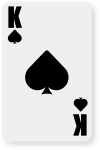
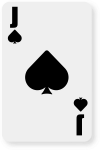
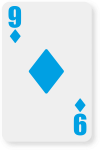
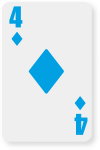
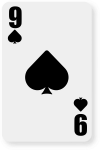
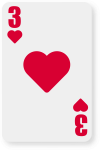
Take the hand below. Unpaired, a 4-card rundown (Q-J-T-9 with a dangling 3), double-suited but with the third heart making it double-triple, and no ace. Instead of "QJT93", you now think "four-card rundown, double-triple, no nut suit" — a category that is a marginal open from late position and a fold from early position.
Now compare it with this hand: unpaired, a 5-card rundown (A-K-Q-J-T), double-suited pure, with the ace suited. That is one of the strongest categories in the game and a 3-bet in many spots.


Try it: the free PLO5 Starting Hand Analyzer applies these three questions to any hand you enter and lists its strengths and weaknesses.
Why this works
- Speed. At the table you have a few seconds. Three quick questions are enough to place a hand.
- Patterns. When you study by category, you notice consistent rules — for example that suit quality matters a lot for 4-card rundowns but much less for perfectly connected 5-card rundowns, because connectivity alone already provides nut potential.
- Thresholds. Within each category, you only have to learn where the cut-off lies in each position, rather than memorising thousands of hands.
The preflop guides on this site follow this structure: aces, broadway pairs, rundowns and double-paired hands. For a practical training routine built on categories, see How to Study PLO5.