Kings, Queens, Jacks and Tens
Why big pairs without an ace are pulling hands in PLO5
In 4-card PLO, double-suited kings are a hand you rarely fold and often 3-bet. In 5-card PLO, kings, queens, jacks and tens lose a remarkable amount of value. Understanding why — and which broadway pairs still deserve aggression — prevents a lot of costly pots.
Why big pairs lose value
- Aces are common. One hand in 24 contains two aces, and many more contain a single ace that blocks your set outs or makes a bigger flush.
- Your suits are not the nut suit. Without an ace, the best you can hold is a king-high flush draw, and with half the field double-suited, king-high flushes are dominated much more often than in 4-card PLO.
- Overpairs are fragile. Opponents have five cards to make two pairs and draws, so a bare overpair rarely survives to showdown in a big pot.
Pulling hands, not pushing hands
Many broadway pairs play best as pulling hands: you call preflop, keep weaker hands in, and hope to flop a set or a strong draw. 3-betting builds a pot in which you are often dominated and has little fold equity. As a result:
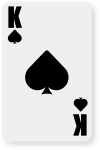
- Pairs of kings without an ace 3-bet very rarely — only the most connected, pure double-suited combinations such as KKQJT or KKJT9.
- Even strong-looking hands like AKKT2 double-suited are usually calls in position; the dangler deuce removes the connectivity they need.
- Against a cutoff open, many double-suited king hands in the small blind simply fold.





When broadway pairs do 3-bet
- With an ace and strong connectivity. AKKJT, AKKT9 and similar pure double-suited hands 3-bet and comfortably call 4-bets.
- Out of position. Broadway pairs realise their equity poorly out of position at a high SPR, so the small blind 3-bets them more often than the button does. Lowering the SPR helps them.
- Against a capped range. When there is an open and a call, the caller rarely has aces. Squeezing frequency with double-suited kings jumps from a few percent to roughly a third of the time.
- At shorter stacks. At 50 big blinds high pairs gain value relative to rundowns and 3-bet much more often.


Facing 3-bets and 4-bets
Broadway pairs that opened usually call a 3-bet; only the roughest, triple-suited combinations fold. Facing a 4-bet is different: this category is the most fragile part of most 3-betting ranges. Kings especially suffer, because the aces in your opponent's 4-betting range kill much of your connectivity. Hands with jacks and tens connected to the rest of the hand (e.g. AJTT8 or ATT87) hold up better than kings.
Single-suited broadway pairs
Without a second suit, broadway pairs need connectivity to be playable:
- Single-suited kings open from early position only when they are very connected, e.g. KKT98 or KKJT9.
- KKQT7 with a king-high suit is a reasonable open from middle position; from early position it folds.
- JJT87 single-suited folds to a raise from the small blind — one gap is enough to make it too weak out of position.
- 3-betting these hands is essentially never correct.




Practical rules
- A broadway pair without an ace needs connectivity to be aggressive. Two high suits alone are not enough.
- Prefer to call in position and keep weaker hands in; 3-bet mainly out of position or against capped ranges.
- Be ready to fold kings to a 4-bet unless they are very connected or double-suited with an ace.
- Don't overvalue the king-high flush draw — in multiway pots it is often drawing to the second-best hand.